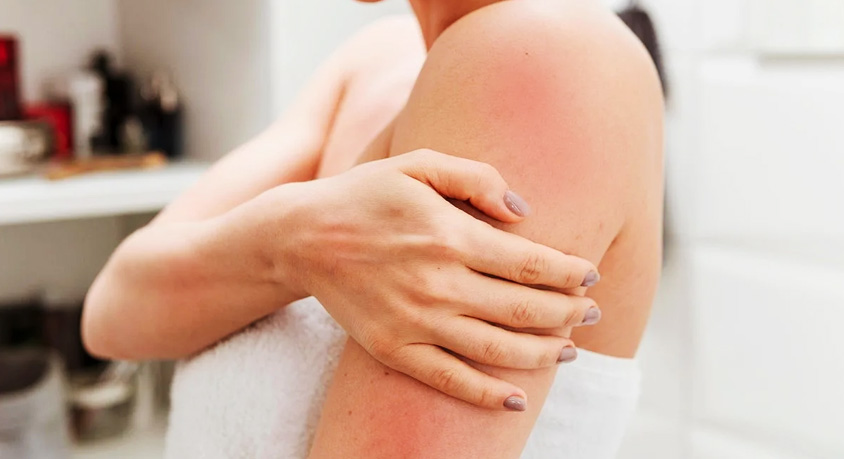
You step out of a warm shower. Within minutes, your back or lower legs begin to itch. You scratch, but it only gets worse. By bedtime, the itch keeps you awake.
E.g. :Non Restorative Sleep Causes and Solutions: How to Fix Poor Quality Sleep and Wake Up Refreshed
- 1、The “Hot Shower Itch” Is a Warning Sign, Not Normal Aging
- 2、Why Regular Moisturizing for Aging Skin Often Fails
- 3、Three Practical Changes That Stop the Itch Without More Scratching
- 4、When Itching Isn’t Just Dry Skin: Red Flags to Watch For
- 5、FAQs
Many older adults assume this is just “part of aging” and reach for any body lotion. But the usual moisturizers don’t help much. The reason? Aging skin doesn’t just get drier—it changes its entire structure. What worked at 40 may fail at 65. And some common habits, like hot showers or using regular soap, actually worsen the itch.
The “Hot Shower Itch” Is a Warning Sign, Not Normal Aging
That intense itching after bathing has a name: aquagenic pruritus in the elderly, or more commonly, senile xerosis (age-related dry skin). It’s not in your head.
As we age, our sebaceous glands produce less oil. By age 70, sebum production drops by nearly 60% compared to young adulthood (source: Journal of Investigative Dermatology, 2018). Less oil means water escapes faster. But oil loss is only half the story.
The real problem: the lipid matrix between your skin cells—made of ceramides, cholesterol, and fatty acids—thins out. This matrix acts like mortar between bricks. When it weakens, water leaks out, and irritants get in. Hot water strips what little lipids remain, then evaporates quickly, triggering nerve endings to fire itch signals.
Why Regular Moisturizing for Aging Skin Often Fails
Standard body lotions focus on adding oil or temporary water. But aging skin needs something else: ingredients that rebuild the barrier and lower the surface pH.
The pH Shift No One Talks About
Healthy young skin has a pH of about 5.0. In older adults, studies show the average surface pH rises to 5.5–6.0 or higher (International Journal of Cosmetic Science, 2019). A higher pH weakens the enzymes that help shed dead skin cells smoothly. Instead of coming off invisibly, dead cells clump together, creating microscopic cracks and a rough texture that invites itching.
Most standard soaps and body washes have a pH of 8–10. Using them further raises your skin’s pH, prolonging the itch cycle.
Urea: The Underrated Ingredient for Senile Xerosis
Unlike regular lotions, formulas with 5–10% urea do two things: they hydrate deeply and gently dissolve the clumpy dead skin cells that trap itch signals. A 2020 clinical trial in Dermatology and Therapy compared a 10% urea lotion against a standard glycerin cream in adults over 65 with senile xerosis. After four weeks, the urea group had a 72% reduction in itch scores, compared to 31% in the standard cream group.
Three Practical Changes That Stop the Itch Without More Scratching
You don’t need expensive prescriptions. You need a different routine.
1. Shorten and Cool Your Showers
Hot water opens pores but strips lipids aggressively. Limit showers to 5–10 minutes at lukewarm temperature (around 37°C / 98°F). Pat skin dry with a towel—do not rub. Leave skin slightly damp.
2. Apply Moisturizer Within 3 Minutes of Bathing
This is called the “golden window.” Damp skin absorbs moisturizer up to 80% better than dry skin. Use a urea-based or ceramide-rich lotion. Avoid products with fragrances or alcohol.
3. Switch to a pH-Neutral Cleansing Oil or Syndet Bar
Look for “syndet” (synthetic detergent) bars with pH 5.5. These clean without raising your skin’s alkalinity. A 2021 study in Skin Pharmacology and Physiology found that switching to a pH-neutral cleanser for four weeks reduced transepidermal water loss (TEWL) by 19% in elderly participants, regardless of moisturizer.
When Itching Isn’t Just Dry Skin: Red Flags to Watch For
Sometimes itching has medical causes. Do not assume it’s always senile xerosis.
Signs You Should See a Doctor
- Itching accompanied by jaundice (yellowing skin or eyes) – possible liver issue
- New rash with blisters or oozing – possible contact dermatitis or infection
- Itching that wakes you at night even after moisturizing – possible kidney disease or thyroid disorder
A 2017 review in American Journal of Clinical Dermatology noted that chronic itch in older adults is often linked to underlying conditions like diabetes, iron deficiency, or renal failure. If your skin improves with better moisturizing but the itch persists elsewhere (scalp, palms, soles), get checked.
FAQs
Q: Is petroleum jelly (Vaseline) enough for elderly dry skin?
A: Not by itself. Petroleum jelly is an occlusive – it traps water but doesn’t add water or remove dead skin. For senile xerosis, you need humectants (urea, glycerin) and emollients (ceramides) first. Apply petroleum jelly on top of a moisturizer, not instead of it.
Q: Can drinking more water cure age-related dry skin?
A: No. Systemic hydration helps overall health, but it does not measurably improve skin barrier function or TEWL in normally hydrated older adults. A 2018 study in Clinical, Cosmetic and Investigational Dermatology confirmed that topical moisturizers are far more effective than increased water intake for senile xerosis.
Q: How often should older adults exfoliate to reduce itching?
A: Avoid physical scrubs. Use a chemical exfoliant like 5–10% urea lotion daily – it works as a mild, gentle exfoliant over time. Do not use glycolic or salicylic acid unless prescribed, as they can irritate thin elderly skin.